Souvenir from St. Mary's Hospital in London: the readout showing where my rapid heart beat was halted, then restarted at a slower pace. Click to see detail.
We go to London for the theater. But a brief visit last week brought some unexpected drama of a different kind.
What happened: in the wee hours of Saturday morning, I awoke to find my heart beating much faster than normal.
And stronger than normal, too: BAM! BAM! BAM!
I couldn't imagine why this was happening at 2 a.m. I hoped it would just go away, but I couldn't get back to sleep.
So after an hour, I woke up my wife. She measured the pulse as 140, and it showed no signs of abating.
What was up? Was it finally time for my big life-changing health collapse?
Time crawled by. Earlier that evening, we had seen 'Fawlty Towers: The Dining Experience,' a dinner-theater recreation of the iconic British TV sitcom.
Now, lying there, I found myself thinking of several 'Fawlty Towers' scenes set in British hospitals, and also of the episode where a hotel guest dies overnight.
That led me to think of a good option for an epitaph, should one be needed. It's what John Cleese says to three hotel guests whom he mistakes for undertakers.
"Your dress is very modern," he tells the bewildered trio. That would work well on a gravestone, I thought.
I know this sounds ludicrous. But what else would you think about in a hotel at 4 a.m. with your heart racing like you're running a marathon?
Daylight came at about 6:30 a.m. By then I was seriously short of breath and feeling light-headed, so we knew I'd have to get checked out.
One issue: my wife's relatives were scheduled to arrive in London by train at 8:50 a.m. for an action-packed day.
Well, it was clear I wasn't up for that. Just climbing the stairs to the lobby (we were in a lower level) made me feel like taking a siesta.
Fortunately, St. Mary's Hospital was two blocks from the hotel. I felt well enough to walk to the ER. So that's what I did.
My wife would meet the relatives at the train and wait to hear from me.
The main gate at St. Mary's Hospital in London.
So I trudged across Praed Street and entered the St. Mary's campus. A map directed me to the emergency department, and a woman at a desk sent me upstairs.
The hotel desk clerk had advised I might want to wait for an urgent care clinic to open because St. Mary's, as a large inner-city hospital, could be kind of a madhouse.
But early on a Saturday morning, I was the only customer. No waiting! Thus was my introduction to Britain's National Health Service.
And get this: besides my symptoms, all they needed from me was my name, address, and (because I was a foreigner) my passport info.
I was then put in a wheelchair and rolled down a corridor to the ER, where I was evaluated by several nurses working as a team. Everyone wore the same blue hospital clothes.
Before long, my chest was partially shaved so they could attach sensor contacts to me. I was placed in a gurney and wheeled into a medical room, with my heart racing as fast as ever.
All this before 8:30 a.m.!
Two doctors, Danny and Helen, tried non-invasive methods to corral my pulse: blowing into a syringe, and then a neck massage.
These had no effect, so the decision was made to use a drug that Dr. Danny warned me had an unusual effect: people who take it, he said, "feel like they're doing to die."
What? They feel like they're dying? What does death feel like, exactly?
What he meant was that the drug, Adenosine, would temporarily stop my heart from beating (for the first time since 1964!), and then very soon after it would start again, ideally at a normal rate.
But that time between was what people described as death: with the heart shut down, the body instinctively goes into shock. The heart restarts before this gets too far, but it can be very scary.
"Can I have a lollipop?" I asked, laying there, still wondering if this was what Redd Foxx used to call 'The Big One' on the old Sanford & Son TV series. (Wow, everything in life is related to TV!)
Before I got an answer, 6 milligrams of Adenosine were released into me through an IV.
I waited for death...but death did not come.
The verdict: I was a bigger moose than they'd figured. Hence the next step: double the dose!
In went 12 milligrams of Adenosine, and then I felt it.
For me, death felt like a huge weight pressing on my chest, and then quickly morphed into the sensation that there was some kind of strong vacuum pulling at my chest from the inside, trying to collapse it.
I closed my eyes in response to this, and found I couldn't open them!
But before anything else happened, my heart resumed beating, and at a much lower pulse rate of 90. It would drop further as I returned to normal.
Laying there, I was overcome with a huge sense of relief that was physical and mental. The moment my heart resumed at a normal rate, everything felt right again, finally.
Also I was relieved that I'd have time to think of a better epitaph than "Your Dress Is Very Modern."
After making sure I was stable, the doctors wheeled me into a holding area, where I needed to stay until they got blood test results back from the lab.
The hospital had great wifi, so I updated the wife and wished them all a good time! I would try to catch up later if I could.
The actual Emergency Department within the hospital, which is named after the Queen Mother, a long-time patron.
So for the next six hours, I got to watch the ER of a busy London hospital in action. It wasn't that busy, actually, but still a lot was going on—a broken femur here, a fall with head injury there.
More than once I heard people being asked "Who is the Prime Minister?" or "Who is on the throne?"
At about noon, Dr. Danny and Dr. Helen came by with an update. My results were fine. But because I was going to be on a long flight the next day, they wanted to keep me for one more round of blood tests as a precaution.
Specifically, they wanted to see if levels of a certain type of enzyme were increasing, which would indicate damage to the heart muscle or possibly another cardiac malfunction in the making.
By 3 p.m., the second results were in: I was free to go. And that's when I got my biggest surprise.
After putting myself back together, I asked Dr. Helen what I needed to do next.
"You're discharged," she said. "You just go."
"Go where?"
"Out of the hospital," she said, realizing that I was one of those foreigners who may not understand how National Health works.
"Isn't there some kind of paperwork I have to fill out—disclosure forms or insurance info?"
"You have a discharge paper, which you should bring to your G.P. back home," she said. "Emergency care is provided free to everyone."
There's a phrase you don't hear in U.S healthcare. Free to everyone!
You mean, I just took up eight hours of time in the ER of a major London hospital, and the cost is...nothing?!
Even better—I found out later that if I had travel expenses, I could take receipts to the bursar's office for possible reimbursement. Wow. In Britain, they pay you to go to the hospital!
But what impressed me most was the sheer simplicity of the transaction. No paperwork. No forms. No codes or waivers or disclaimers or disclosures.
And no gigantic billing infrastructure that adds to costs without medically helping anyone.
Of course there are costs. Someone had to pay for the services I received. In this case, it was the British taxpayer.
It didn't seem proper to take photos inside the ER, but I did furtively snap this one shot of my "holding cell," which had a nice view of a canal filled with houseboats.
But that same taxpayer does not have to pay always-rising insurance premiums or cope with massive deductibles like we do.
Example: Last month I had an MRI done as a precaution. The total cost for this two-hour procedure was just under $10,000, of which I had to pay 20 percent.
Thinking about that bill would be enough to prompt a cardiac incident.
But in my case, what seems to have been the culprit in London was me unthinkingly downing five or six cups of coffee during the previous day, and then drinking beer and wine in the evening, topped off by more coffee.
By the time we got back to the hotel, it's no wonder my heart went into overdrive.
But I'm fine now. It's been three days and no sign of any relapse. I even had a cup of coffee today!
So all's well that ends well. Speaking of which, I do need to work on finding a better epitaph.
Monday, February 13, 2017
Friday, May 29, 2015
Visiting Vietnam: Home of weasel coffee
People ask me why I'm going to Vietnam this summer, and now I have a very specific answer: for the weasel coffee.
I had never heard of weasel coffee until I came across this reference in a travel book I was leafing through.
"Vietnamese coffee is unique, and comes in a wide selection of flavors, including vanilla, anise, and chocolate. There are three varieties of coffee -- Arabica, Robusta, and Weasel."Weasel coffee? What could this mean? Read on...
"While Arabica is the most expensive and richest, Robusta is cheaper. Weasel is also expensive and is made from coffee cherries eaten and defecated by chon, Vietnam weasels."Yes, coffee made from beans that have gone through a weasel's digestive track! Count me in!
Aw, isn't he cute?
As I understand it, the digestive process basically "pre-treats" the beans, partially fermenting them and removing bitterness and other off flavors. After the beans are excreted, they're collected, cleansed thoroughly (one would hope), and then roasted.
I checked this out, and what you start with (after the weasel part of the process) basically looks like a Baby Ruth bar with way too many nuts:
And yes, the resulting coffee beans are considered a great delicacy and command a high price as a luxury item (up to $500 per pound) in Vietnam and other places along the Pacific Rim. I'm not making this up. Check out this deluxe gift box set from Japan:
Weasel coffee has prompted some inspired copywriting. Consider this sample I found from an online seller:
"On the eastern edge of the Dak Lak province in central Vietnam, we found a coffee plantation that was willing to sell us a small amount 100% weasel coffee. These are domesticated weasels, that live in a large cages, like zoo animals, and are fed coffee along with other foods. The quality of the product is exquisitely rich, with a chocolate overtone and creamy mouth feel. The street price of this coffee in Hanoi is $800 USD per kilo. We sell in 100 gram packages and custom grind to your specification. One of my clients wrote recently and emphatically stated: 'this is absolutely the most delicious coffee I've ever tasted.' See if you agree!"Eager for more? Check out http://www.weaselcoffees.com/.
This whole ghastly concept quickly joined my list of things that make traveling worthwhile. One can only shake one's head in wonder at what people get up to.
How could this even happen? Turns out there's a logical explanation that, alas, involves European imperialism.
Back in the 19th century, French colonists wouldn't let local people share in the harvests of Robusta coffee beans.
So the people resourcefully extracted the beans from weasel dung, setting the stage for one of the world's most unusual culinary experiences.
Some folks say the weasel's ability to select only the "best" beans worth eating is another factor in why the resulting coffee is so highly regarded.
Today, varieties of weasel coffee are also produced in Indonesia and the Philippines. But I'm sorry to report that the United States, despite its agricultural prowess, is not a player in this lucrative field. Geez, we can put a man on the moon, but...
Although "authentic" weasel coffee can cost $50 a cup, versions made with other ingredients that mimic the flavor are much more reasonable. That's what I expect I'll seek out in July, when we're marching around the streets of Hanoi and Ho Chi Minh City.
So who'll join me in a nice refreshing cup? And afterwards, we'll all join together in a chorus of "Poop Goes the Weasel!"
Click for heartwarming video.
Monday, December 29, 2014
Just call me KYLE: Thoughts on departing
to climb Mount Kilimanjaro in Africa
"Vacation" is definitely the wrong word for this.
A better way of putting it might be: "Planned near-death experience."
How else to describe a journey that will take us far above treeline, into air with only half the amount of oxygen that we're used to, trudging across volcanic pumice and living for a week in tents but otherwise exposed to the elements?
By elements, I mean jungle rains followed by extreme cold (well below zero at night) and potentially stiff winds at all hours. And it all takes place under the intense equatorial sun, which gets more intense the higher we go (despite the cold) because there's less of the Earth's atmosphere to protect us.
Oh, joy! But this is what it takes to reach the summit of Mount Kilimanjaro, the highest point in all of Africa. And that's what I'm going to try to do, starting in a few days, with a group of 11 other intrepid adventurers.
Some I've known for years, other I'll meet for the first time at Amsterdam Airport. That's where we change planes on New Year's Day for our flight to Tanzania. Kilimanjaro lies just below the equator, and just south of Tanzania's border with Kenya.
Kilimanjaro rises about 15,000 feet above the surrounding plains, making it the tallest free-standing mountain in the world.
We'll be joined by a support group of no less than 45 others—a team that includes our guide, five assistant guides, three cooks, and several dozen porters to carry in (and out) everything needed for the expedition.
We start on Saturday, Jan. 3. For seven days, we'll trek about 35 miles along the slopes of this gigantic dormant volcano, through five different climate zones. We'll slowly gain height, giving our bodies a chance to get used to the high altitude.
And it all culminates on Saturday, Jan. 10, when we'll be wakened before midnight. We'll then don our headlamps for the final overnight push along a ridge and up to the summit. It's done in the wee hours because the scree is frozen in place at night, making footing much easier, I'm told.
And if all goes well, we'll reach the volcanic crater rim about sunrise, and the actual summit (at 19,344 feet) a bit later. After spending only minimal time at the top, with its very dangerous lack of oxygen, we then make a quick descent, going down about 7,000 feet before the end of that very long day.
The summit of Kilimanjaro. You can see how it's a dormant volcano. We're aiming for the ridge on the right, Uhuru Peak, the actual highest point.
That's one big honking "if," of course. Any number of things could keep some or all of us from getting there. But it's doable. So we're doing it, at least trying.
So apologies to Yoda, who famously pronounced "there is no try." But then Yoda never attempted Kilimanjaro, as far as I know.
Doing it, or even trying to do it, requires equipment, including a duffel bag of a certain size, which I didn't have.
So I went shopping, and found that the local L.L. Bean store had several racks of returned canvas duffel bags at a hefty discount off retail.
The reason for the discount: all the returned bags had been personalized with embroidered initials or names!
So I looked through them, and narrowed it down to a dark green bag labelled "KYLE" in block capitals and a blue one with "Annemarie" stitched in cursive.
I chose KYLE because of the color, although I have to admit I'd feel a little funny using a bag with "Annemarie" on it to climb Kilimanjaro.
So KYLE, I don't know who you are, but the bag you rejected is going on quite a trip in a few days.
In some ways, it's kind of like the Apollo moon voyages some years ago. We spend all this time and preparation and effort to reach a very inhospitable place, where we stay for only a very short time before high-tailing it out of there and back to safety.
One way it's not like a 1960s moon voyage, however, is that we will be out of communication for most of our journey. With the astronauts, as far away as they were, at least they could always tell Houston if they have a problem. (Except for brief periods when orbiting the far side of the moon.)
On Kilimanjaro, there may or may not be cell signals or what-not available. But I'm not bringing my cell phone and will be genuinely off the grid for more than a week.
There have been good omens. I went to a local credit union the other day to do some year-end banking for my mother, and the guy who sat down with me was from Zimbabwe, just south of Tanzania.
Also, I discovered a wonderful store, Travel & Nature Adventure Outfitters in Exeter, N.H. and was delighted to discover that proprietors Robert and Sue Garneau summitted Kilimanjaro on their honeymoon back in the 1980s!
Heck, even the guy that does my taxes climbed Kilimanjaro last summer. Everyone's doing it!
Most interesting of all, earlier this month I learned that the conductor of the New Hampshire Philharmonic, Mark Latham, is the grandson of the first Englishman to summit Kilimanjaro, which happened back in 1926.
Mark was gracious enough to have dinner with me and two other Granite Staters on our expedition, Dave and Patsy Beffa-Negrini.
He brought along his grandfather's vintage photo album from the actual expedition, which included photos of the guy hoisting aloft a frozen leopard he'd found at high altitude.
This discovery, widely reported and remarked upon at the time, became a symbol that inspired Ernest Hemingway to write 'The Snows of Kilimanjaro,' a mountain he never actually visited or climbed himself. Just like Yoda.
But that didn't stop him from constructing a novel using the mountain and the leopard as highly potent symbols for...well, here's a brief description from no less an authority than "Cliff's Notes":
"During his otherworldly flight over Kilimanjaro, Harry sees the legendary leopard. The dead, preserved leopard can be seen as a symbol of immortality, a reward for taking the difficult road. Harry himself was a "leopard" at certain times in his life, as were some of his acquaintances in his own stories. Specifically, Harry can be seen as a leopard during...
• His youth, when he lived in a poor neighborhood of Paris as a writer
• In the war, when he gave his last morphine pills for himself to the horribly suffering Williamson
• On his deathbed, when he mentally composes flashbacks and uses his intention to write
• When he stays loyal to his wife and does not confess to her that he never really loved her
Some mystic impulse within Harry and within the leopard drove them to seek out God, or the god within themselves, or immortality that resided far from ugly, mundane reality.
In most civilizations, God or God's promise of immortality resides on the highest mountain top: Mount Olympus for the Greeks, Mount Sinai for the Hebrews, Mount Fuji for the Japanese. If the leopard was searching for some sort of immortality, then it found immortality at the summit of Kilimanjaro, where it lies frozen — preserved for all eternity.
When Harry looks at Kilimanjaro, he sees it as a symbol of truth, idealism, and purity. When he dies, tragic irony exists. The leopard died in a high, clean, well-lighted place; Harry, in contrast, dies rotting and stinking on the plains, lamenting his wasted life and his failure to complete his desired projects.
I'm not reading Hemingway's book, or doing any other kind of advance mental preparation for this adventure, other than to try to clear my mind of all expectations. I'd like to remain as open as possible to what I discover on my own.
I know I'm looking forward to the night sky on Kilimanjaro. Because of the high altitude and the lack of human-produced light pollution, I'm told it's unlike anything visible where I live in North America.
I'm looking forward to looking down on the clouds, if that happens. I'm told it's very similar to what you see outside the window of a plane, only without the plane.
But most of all, I think I'm looking forward to the experience, and seeing if I really can do this. I'll figure out what it means later on.
Heck, I might even change my name to KYLE.
Labels:
Africa,
Apollo,
Ernest Hemingway,
Kilimanjaro,
Mark Latham,
Mount Kilimanjaro,
Tanzania
Wednesday, November 6, 2013
Wednesday, June 19, 2013
Regional flavor revisited
Something surprising in a news story about a restaurant opening in Manchester, N.H. To quote the proprietor: "The menu will be very similar to what is offered now in Merrimack and Milford. Cheung described it as “traditional New England Chinese,” with a few twists, including a Japanese-style sushi bar."
Traditional New England Chinese. Talk about fusion cuisine!
Thursday, May 30, 2013
Boy, do I like this...
“The important thing is that there should be a space of time, say four hours a day at the least, when a professional writer doesn’t do anything but write. He doesn’t have to write, and if he doesn’t feel like it, he shouldn’t try. But he is not to do any other thing, not read, write letters, glance at magazines. Two very simple rules, a: you don’t have to write. b: you can’t do anything else. The rest comes of itself.”
—Raymond Chandler
—Raymond Chandler
Sunday, February 3, 2013
Forgetting about the calendar
The whole year, spread out for you on one page.
If you didn't know what date it was, would that influence what you did or how you felt as you went about living today?
Say you didn't know the name of the month, or the day of the week. Or that you had no way to relate this day—today—to any in the past or any in the future. It's just today.
I suspect you'd feel more buoyant and more free because of it, and that life would seem to have more possibilities. I think you'd feel more optimistic.
Just as one feels lighter and more buoyant after a house gets decluttered, a person might benefit from forgetting the constant framework of passing time that surrounds us: hours, days, months. The subconscious "calendar" function in our brain would be deactivated, dissolving a set of limitations that perhaps hem us in and hold in check our emotions, our imaginations, and maybe much more. Who knows?
Alas, this act of forgetting is not easy to do, with time or with anything else.
My own personal experience in the difficulty of forgetting involves something that happened to me with music.
Consider: Beethoven wrote his 'Pastoral' Symphony No. 6 to depict specific scenes in nature: a babbling brook, bird calls, a storm, and so on. The piece is loaded with musical "tone-painting," and has long been accepted as a masterful example.
Okay, now to Leonard Bernstein. In his book 'The Joy of Music,' Bernstein wrote about the difficultly of listening Beethoven's Symphony No. 6 just as music, with the "Pastoral" removed. Could it even be done? Once you knew Beethoven's 'nature' angle, could you ever not know that, and just hear the music as music?
Bernstein believed it could—that a trained musician could indeed "forget" Beethoven's nature program and just regard the symphony as "absolute" and abstract music, just like its much more iconic predecessor, the Symphony No. 5, which is full of drama and beauty but tells no specific story and paints no specific scenes.
Beethoven, in a relatively good mood. Possibly having a bad ear wax day?
Why bother? Because, Bernstein wrote, it allows one (either a musician or a listener) to experience a familiar piece of music—a warhorse, really—in a totally fresh and new way. And that can have immense value in keeping a masterwork compelling across the generations, rather than have it sink beneath the weight of familiarity and accepted notions. If you can forget the program, what was once a warhorse is remade entirely. It can be heard fresh!
The notes haven't changed. Just your attitude has—because you've forgotten something about it.
I know this is true because it actually happened to me with this very piece of music. As a teenager who was into classical music (yes, it was a rough adolescence), I remember tuning into a Boston Symphony Orchesta radio broadcast from Tanglewood one summer. The concert had started and I didn't know what piece was being played, but it held my attention immediately. I was transfixed: it sounded familiar, like something out of the standard classical "Haydn-Mozart-Beethoven" era, but was also altogether different.
It was slow, and didn't seem to have a melody. Instead, it was more of a texture. The music ambled along, filled with graceful clarinet arpeggios and trilling woodwinds and not seeming to have any forward motion, but with one remarkable passage following another.
The music ended, and I was going crazy. What was it? When the next movement began, I recognized the piece right away. I had played the "second half" of Beethoven's 'Pastoral' many times (for the exciting storm sequence), but had never paid attention to what I thought would be the "boring" slow movement. Now I had just heard it, and with no idea what it was, and I thought it was great!
In this case, I hadn't forgotten anything. Instead, I just hadn't yet learned. But still, I was able to experience for real what Bernstein was talking about: the power of forgetting.
Which takes us back to the question of the calendar. How much of what we see and experience and feel about today is linked to our all-to-human awareness of it being Sunday, Feb. 3, 2013? A specific day with a specific number, related as such to all days before and all days to come. A framework that was in place before we were born and will live on after we're gone. Kinda smothering, in a way.
Does this knowledge in limit us? If we could somehow forget the day, the month, the year, would that allow us to be more fully in the moment right now? Would being able to disconnect from the calendar be like a housecleaning or decluttering of sorts, and result in us feeling more buoyant and light and full of possibility?
I think there's something there. And anyway, if the act of 'forgetting' is good for our soul, then I'm way ahead of a lot of folks just with what keeps happening with my car keys.
If you didn't know what date it was, would that influence what you did or how you felt as you went about living today?
Say you didn't know the name of the month, or the day of the week. Or that you had no way to relate this day—today—to any in the past or any in the future. It's just today.
I suspect you'd feel more buoyant and more free because of it, and that life would seem to have more possibilities. I think you'd feel more optimistic.
Just as one feels lighter and more buoyant after a house gets decluttered, a person might benefit from forgetting the constant framework of passing time that surrounds us: hours, days, months. The subconscious "calendar" function in our brain would be deactivated, dissolving a set of limitations that perhaps hem us in and hold in check our emotions, our imaginations, and maybe much more. Who knows?
Alas, this act of forgetting is not easy to do, with time or with anything else.
My own personal experience in the difficulty of forgetting involves something that happened to me with music.
Consider: Beethoven wrote his 'Pastoral' Symphony No. 6 to depict specific scenes in nature: a babbling brook, bird calls, a storm, and so on. The piece is loaded with musical "tone-painting," and has long been accepted as a masterful example.
Okay, now to Leonard Bernstein. In his book 'The Joy of Music,' Bernstein wrote about the difficultly of listening Beethoven's Symphony No. 6 just as music, with the "Pastoral" removed. Could it even be done? Once you knew Beethoven's 'nature' angle, could you ever not know that, and just hear the music as music?
Bernstein believed it could—that a trained musician could indeed "forget" Beethoven's nature program and just regard the symphony as "absolute" and abstract music, just like its much more iconic predecessor, the Symphony No. 5, which is full of drama and beauty but tells no specific story and paints no specific scenes.
Beethoven, in a relatively good mood. Possibly having a bad ear wax day?
Why bother? Because, Bernstein wrote, it allows one (either a musician or a listener) to experience a familiar piece of music—a warhorse, really—in a totally fresh and new way. And that can have immense value in keeping a masterwork compelling across the generations, rather than have it sink beneath the weight of familiarity and accepted notions. If you can forget the program, what was once a warhorse is remade entirely. It can be heard fresh!
The notes haven't changed. Just your attitude has—because you've forgotten something about it.
I know this is true because it actually happened to me with this very piece of music. As a teenager who was into classical music (yes, it was a rough adolescence), I remember tuning into a Boston Symphony Orchesta radio broadcast from Tanglewood one summer. The concert had started and I didn't know what piece was being played, but it held my attention immediately. I was transfixed: it sounded familiar, like something out of the standard classical "Haydn-Mozart-Beethoven" era, but was also altogether different.
It was slow, and didn't seem to have a melody. Instead, it was more of a texture. The music ambled along, filled with graceful clarinet arpeggios and trilling woodwinds and not seeming to have any forward motion, but with one remarkable passage following another.
The music ended, and I was going crazy. What was it? When the next movement began, I recognized the piece right away. I had played the "second half" of Beethoven's 'Pastoral' many times (for the exciting storm sequence), but had never paid attention to what I thought would be the "boring" slow movement. Now I had just heard it, and with no idea what it was, and I thought it was great!
In this case, I hadn't forgotten anything. Instead, I just hadn't yet learned. But still, I was able to experience for real what Bernstein was talking about: the power of forgetting.
Which takes us back to the question of the calendar. How much of what we see and experience and feel about today is linked to our all-to-human awareness of it being Sunday, Feb. 3, 2013? A specific day with a specific number, related as such to all days before and all days to come. A framework that was in place before we were born and will live on after we're gone. Kinda smothering, in a way.
Does this knowledge in limit us? If we could somehow forget the day, the month, the year, would that allow us to be more fully in the moment right now? Would being able to disconnect from the calendar be like a housecleaning or decluttering of sorts, and result in us feeling more buoyant and light and full of possibility?
I think there's something there. And anyway, if the act of 'forgetting' is good for our soul, then I'm way ahead of a lot of folks just with what keeps happening with my car keys.
Saturday, January 26, 2013
The problem with Scrooge
Like a lot of people, I sometimes wonder about the arc of my life.
I'm now in the final stretch before turning 50, and I sense that the din of daily life is beginning to subside just a bit. Guess what? I've lived more than half my years. As nephews and nieces grow up and begin lives of their own, I'm now starting to get maybe just a hint of the quietness and solitude of future old age.
Increasingly, my own future will be the result of past decisions I've made and attitudes I've held for lo these many years. Right? And the world will keep turning, and you won't necessarily be involved or even approve. And at some point, grace is the ability to accept all that and come to terms with it. Right?
But, on the other hand, there's Scrooge. You know -- the old Christmas-hating miser in 'A Christmas Carol' by Charles Dickens. My whole life, I've always been drawn to this story, especially because of the emotional payoff at the ending. I always responded to how even old Scrooge could find it within himself to change his ways, and just decide to help so many people and create such happiness after all.
As the years have rolled by, I've had a growing sense of how my response to that ending might be increasingly a kind of wish fulfillment that might apply to me personally. Hey, if Scrooge could undergo a miraculous transformation, then I might be capable of that, too! It's not too late. Anything can happen! Life is full of possibilities!
Ah, but then I've recently begun to wonder about one aspect of Dickens' tale that troubles me. Scrooge has money. Lots of it. And would the reaction to his transformation be quite so positive if he wasn't loaded with dough?
Think about that. Would everyone be so happy about old Uncle Ebenezer if, instead of owning the counting house, that he'd had Tom Cratchit's job instead? A lowly clerk with a clerk's salary, weighed down by a hardened heart and a chronically bad attitude toward his fellow man? What would happen if he was miraculously transformed?
Well, the few people in his life would be far less impressed, I think, because what would he have to really offer them? For many people, sudden good cheer would be a cause for suspicion. In fact, in my experience, it's unwelcome, especially in the face of dire circumstances. It would be looked at as yet another burden: geez, now he's manic-depressive! And by the way, why should we believe anything about this sudden transformation when you've proven again and again over the years that you'll let us all down. How can we trust you? And now, given this behavior, we have reason to trust you even less.
What a difference a bag of money makes. And even though I've just starting thinking about this aspect of the Scrooge tale, I think I've sensed it all along. Why? Well, for one thing, I've always been uncomfortable in any situation where I'm not earning at least some money. This unconscious awareness is perhaps at the root of my middle-class existence.
In terms of Scrooge, it would be fun to re-imagine that story, in the same way I'm re-imagining 'It's a Wonderful Life' for my first novel. We'll see. Meanwhile, I'll wait awhile longer for my own miraculous transformation. I just hope it's not on a weeknight, because I need to a full night's sleep or I'm grouchy all day.
Labels:
Charles Dickens,
It's a Wonderful Life,
Scrooge
Monday, October 22, 2012
Exploring excess: A diamond planet?
Imagine that! An entire world made of a form of carbon that some people on Earth have killed for.
My first thought is, of course, "This can't be good." Just think of Homer Simpson's daydreaming about a world made entirely of chocolate, and I rest my case.
Humans need to dream of excess, I guess, but we rarely think through the consequences. Take, for example, Rumplestiltskin, who had a talent for spinning plain old straw into precious gold.
What if someone found a way to actually do that? To actually spin straw into gold? Don't we realize that everyone would start doing it right away, causing a glut of gold and a worldwide shortage of straw?
Don't people understand how the world works?
Labels:
diamond,
gold,
Homer Simpson,
planet,
Rumplestiltskin
Friday, September 7, 2012
The anti-gravity jamboree, or...
like shooting buffalo from a moving train
I find it amazing to live in an age when I can fall out of bed in New Hampshire, drive all of eight minutes in my car to the Manchester Airport, and then take a seat on a machine that will fly through the air all the way to Denver, Colo., arriving before 9 a.m. local time.
Think about that. It's barely past breakfast, and I'm in a city more than 1,500 miles from home, looking at the shards of a broken beer bottle on a sidewalk. And I haven't broken a sweat. Not long ago, this would have been just plain unthinkable. Now it's possible for anyone who can pay $120 to Southwest Airlines and produce a government-issued photo ID.
What's more, I can spend the whole day in this far-off place, then board a similar machine that will fly through the air all the way back without stopping (for another $120), landing at the very same place I came from and enabling me to climb back in that same bed where I began before Jimmy Fallon's show comes on the television.
That pretty much describes what I did on Thursday, Sept. 6, 2012, a day in which I gave in to the present-day wonder of inexpensive commercial air travel. I also got to run 10K in the suburban developments near the airport, and so added Colorado to my quest to run that distance in all 50 states. You can read about that adventure on Running the 234, another blog.
I say "present day" because no one knows how long magically cheap flights will last. Energy prices, global environmental concerns, and just plain economics may soon render air travel hideously expensive or perhaps even illegal. We may one day look upon today's cheap and frequent flights, with jet engines blasting away in the fragile upper atmosphere, as a bizarre aberration.
Heck, commercial aviation may even seen as criminal behavior, like those people on the first transcontinental trains who shot wild buffalo from the open windows just for the fun of it. Like this:
So with air travel, count me in. Every day, aircraft soar over my backyard on their way out to distant places. Today, I will not be satisfied to watch from below, but will take part in the anti-gravity jamboree, rocketing through the sky with all the others and making for the horizon. It's a feat that until now was beyond the most powerful figures in history, and I can do it for the price of getting my riding mower tuned and lubed.To me, air travel is the equivalent of a rip in the time/space continuum, not in science fiction but right here in front of us, right now. If there really was a rip the space/time continuum that transported you 1,500 miles away, wouldn't you want to step through it? It's relatively slow as time portholes go (four hours to Denver?), but what a fantastic thing to have access to.
And yes, I know, few people think of commercial air travel as magical, which is a great illustration of how humans can get used to anything. I think of a passage from Kurt Vonnegut in which he describes our addiction to "molten glurp" (oil) and cheap energy that enables a fat old lady to enjoy an iced beverage and go 60 miles an hour while picking her nose and listening to the radio. Magic, right? But no one today regards that as out of the ordinary.
One reason I still feel this way is perhaps due to a personal connection. My father was a commercial airline pilot. It was many years ago, and he's long gone now, having died when I was 4. But flying was a big part of his life. So today, flying for me (even as a passenger) is a way of communing with his spirit, or at least a vague way of putting my own life in perspective and seeing it from a distance.
Once airborne, I look out the window and see what he saw, the view from his office. (At about $30 an hour, it's relatively cheap therapy.) While the engines roar and the air blasts by outside, I feel connected to him, the same way dropping flower petals in the Ganges is supposed to connect you to your ancestors.
Taking off from Denver, the sun is low in the western sky, lighting up everything at the airport like it's on a stage set. We take off, climbing towards a dark overcast in the east, but the late summer landscape of ranches and fields below us is bathed in a warm yellow light. The colors are pastel. Long shadows throw the rolling knolls into voluptuous relief.
I look out the window, and I can sense why my dad wanted to spend so much time up here.
Tuesday, August 28, 2012
The benefits of global warming
On Monday, Aug. 27, the New York Times carried a story describing how the amount of ice in the Arctic Ocean is currently at its lowest recorded level, and we still have a month of melting to go before it starts its seasonal build-up.Much of the story focused on comments from scientists blaming human activity for the melting. What really stood out, however, was this sentence in the second half of the story:
"The melting does, however, offer some potential benefits, including new shipping routes and easier access to oil and other mineral deposits. A rush is on to stake claims and begin mineral exploration in the Arctic."
Great! One of the benefits of melting, which was caused by human activities, is that it opens up more areas for oil extraction.
Does anyone else see the problem here?
I believe that one of the basic qualities of being human is the ability to recognize a paradox. Well, with this article, we just got a little less human.
Sunday, August 12, 2012
Very important thoughts...
...can be found elsewhere. Meanwhile, there's this:
• Isn't evaporation awesome? I mean, imagine how terrible it would be if liquid water just didn't disappear into the atmosphere like it does. We'd just be wet all the time, especially after a rainstorm. Our hair would never dry. And so on.
• Here's a great quote from Walt Whitman's 'Song of Myself,' which I would like to read someday:
• Why is global warming a concern when all I hear about is polarization?
• When I was a kid, for years I thought 'The Charge of the Light Brigade' was a poem about electricity.
• Isn't evaporation awesome? I mean, imagine how terrible it would be if liquid water just didn't disappear into the atmosphere like it does. We'd just be wet all the time, especially after a rainstorm. Our hair would never dry. And so on.
• Here's a great quote from Walt Whitman's 'Song of Myself,' which I would like to read someday:
Do I contradict myself?• Another nice notion, which I heard somewhere on National Public Radio: "Truth is what everyone right now declines to argue about."
Very well then I contradict myself,
(I am large, I contain multitudes.)
• Why is global warming a concern when all I hear about is polarization?
• When I was a kid, for years I thought 'The Charge of the Light Brigade' was a poem about electricity.
Labels:
evaporation,
global warming,
polarization,
Walt Whitman
Thursday, August 2, 2012
BP: Small-time compared to this!
• In an age of heightened environmental awareness, is the above insignia really the best way to promote a brand of paint?• Unfair competition? The 2016 Olympic Summer Games in Rio De Janiero will actually take place in winter. What can be done about this hemisphere bias?
• Do dog owners really look like their pets? I have to say this seems to be the case. And so among the conclusions you can reasonably draw is that because people choose their pets, then people generally see their own image as desireable.
• I was struck by how 18th century astronomers were able to use the Transit of Venus in 1761 and then 1769 to calculate the actual distance between Earth and the sun. Simple equipment but extremely elegant logic and calculations allowed insight into realities beyond our immediate grasp. Make me wonder if there's not a way to tease out truths about our existence from the mundane and humdrum lives we all lead. Is there a parallax of the soul?
• When nothing else is going right, read a book by David McCullough. Right now I'm going through "Pathway Between The Seas," his 1977 history of the construction of the Panama Canal. Wow, I had no idea how bad a pesthole Panama was!
Sunday, July 1, 2012
Actual dialogue from my house
The Scene: Wife opening gallon can of white paint in kitchen. Husband holding piece of half-eaten peanut butter on toast.
Husband: Wow, look at that! Can I smell it?
Wife: Just don't get any toast crumbs in it.
Husband leans to put nose close to paint, then inhales deeply.
Husband: Ahhh, volatile organic chemicals! It reminds me of my childhood.
Husband: Wow, look at that! Can I smell it?
Wife: Just don't get any toast crumbs in it.
Husband leans to put nose close to paint, then inhales deeply.
Husband: Ahhh, volatile organic chemicals! It reminds me of my childhood.
Sunday, April 29, 2012
"Let's run government like a business."
Here's the best, most cogent response to this I've seen in a long time. It's from an editorial in the Economist in January 2012 responding to a debate about the profitability of Amtrak, the government-run U.S. passenger rail company.
"But framing the discussion around a weird notion of "profitability" isn't particularly helpful. Here's a good rule of thumb: if a government entity's profitability is the main thing you're worried about, it probably shouldn't be a government entity. Nobody worries about the military or the courts being "profitable". It's probably not the right question about Amtrak, either."
Yes, government functions can be run in business-like fashion. Efficiency is good. But to assume that all functions of government should make a profit defeats the whole purpose of getting government involved in the first place. There.
"But framing the discussion around a weird notion of "profitability" isn't particularly helpful. Here's a good rule of thumb: if a government entity's profitability is the main thing you're worried about, it probably shouldn't be a government entity. Nobody worries about the military or the courts being "profitable". It's probably not the right question about Amtrak, either."
Yes, government functions can be run in business-like fashion. Efficiency is good. But to assume that all functions of government should make a profit defeats the whole purpose of getting government involved in the first place. There.
Labels:
Amtrak,
government,
profitability,
The Economist
Sunday, December 25, 2011
The Language of Politics
Two language-related things are on my mind this morning, enough so to write about them here.
• I'm disenchanted at just how entrenched the "liberal/conservative" distinction has become in the United States, as if it's a distinction that comes from nature, such as "man/woman" or "day/night." It isn't. It's just a nearly useless distinction that inhibits creative thinking, impedes our ability to communicate, and oversimplifies everything. It reduces options at a time when we need flexibility, and divides us when we need cooperation. Thanks to win-at-all-cost blowhards on the right who have propagated this distinction for the past two decades, thus coarsening the nation's political dialogue for a generation, maybe more.

• I'm tired of hearing about "job creation" as the aim of government policy, as if the direct purpose of government is to create jobs. It isn't. Business creates jobs. Government oversees business to protect the people. Thinking that government itself can create jobs is like thinking that straw can be spun into gold. It can't. And thinking this shows a lack of understanding of how economic wealth is created. It is created by adding value. Government does not do this.
Talk of government "creating jobs" sounds especially silly coming from politicians who seek to reduce the role of government in the lives of citizens. Okay, I know such people actually mean they want government to get out of the way so businesses can grow and prosper. These days, however, businesses often seek growth not by hiring people, but by being more efficient, which means using fewer people, or outsourcing work to places where labor is cheaper. But I digress.
Back to the idea that government can create jobs. This reminds me of when my brother travelled to Norway in the 1980s as part of U.S. Army cold weather survival exercises with the Norwegian military. He and his squadron flew commercially, and had to change planes at London's Heathrow Airport. While there, he was amazed to see women standing at the bottom of escalators whose job was to stand in place and urge people to use caution when mounting the moving staircase.
Absurd, right? Even after a decade of Thatcherism (including, by then, privatization of British Airways), what my brother thought of as "the post World War II British welfare state" was still alive and kicking. However you feel about it, that's the result when government creates jobs.
So let's stop talking about government as if it can create jobs. We're giving it way more credit that it deserves. Businesses create jobs. And people create businesses. And government, ideally, has as much to do with the process as the referee in a hockey game.

• P.S. In reading new coverage about politics, I've noticed a verb that's suddenly being used everywhere. It's "to pivot," as in a candidate pivoting during a campaign. It's used like this, seen on www.politico.com last week: "The pivot to attacking Paul marks the first time Gingrich has launched an unprovoked broadside against another Republican candidate."
The implication, I guess, is that a candidate keeps his or her positions and efforts and overall operation intact, but now swings them in some new direction without the use of much additional energy or groundwork, rather like one of those machine guns mounted on the back of a pick-up truck often seen in ungoverned regions. Well, that's not the most encouraging illustration, but that's what comes to mind when I hear the word.
I suppose it's a useful expression, but I'm suspicious of any sudden increase in the use of any word or phrase in a new context. If it was that useful, it would have been out there more often all long, right? So to me, a sudden new buzzword smells of flavor-of-the-month intellectual laziness, a kind of mental shorthand that does not enhance our ability to communicate with precision. It's just one more brick in the wall of thoughtless thinking, another step on the road to the city where we don't have the ability to think for ourselves.
I hope civilization never pivots that way.
• I'm disenchanted at just how entrenched the "liberal/conservative" distinction has become in the United States, as if it's a distinction that comes from nature, such as "man/woman" or "day/night." It isn't. It's just a nearly useless distinction that inhibits creative thinking, impedes our ability to communicate, and oversimplifies everything. It reduces options at a time when we need flexibility, and divides us when we need cooperation. Thanks to win-at-all-cost blowhards on the right who have propagated this distinction for the past two decades, thus coarsening the nation's political dialogue for a generation, maybe more.

• I'm tired of hearing about "job creation" as the aim of government policy, as if the direct purpose of government is to create jobs. It isn't. Business creates jobs. Government oversees business to protect the people. Thinking that government itself can create jobs is like thinking that straw can be spun into gold. It can't. And thinking this shows a lack of understanding of how economic wealth is created. It is created by adding value. Government does not do this.
Talk of government "creating jobs" sounds especially silly coming from politicians who seek to reduce the role of government in the lives of citizens. Okay, I know such people actually mean they want government to get out of the way so businesses can grow and prosper. These days, however, businesses often seek growth not by hiring people, but by being more efficient, which means using fewer people, or outsourcing work to places where labor is cheaper. But I digress.
Back to the idea that government can create jobs. This reminds me of when my brother travelled to Norway in the 1980s as part of U.S. Army cold weather survival exercises with the Norwegian military. He and his squadron flew commercially, and had to change planes at London's Heathrow Airport. While there, he was amazed to see women standing at the bottom of escalators whose job was to stand in place and urge people to use caution when mounting the moving staircase.
Absurd, right? Even after a decade of Thatcherism (including, by then, privatization of British Airways), what my brother thought of as "the post World War II British welfare state" was still alive and kicking. However you feel about it, that's the result when government creates jobs.
So let's stop talking about government as if it can create jobs. We're giving it way more credit that it deserves. Businesses create jobs. And people create businesses. And government, ideally, has as much to do with the process as the referee in a hockey game.

• P.S. In reading new coverage about politics, I've noticed a verb that's suddenly being used everywhere. It's "to pivot," as in a candidate pivoting during a campaign. It's used like this, seen on www.politico.com last week: "The pivot to attacking Paul marks the first time Gingrich has launched an unprovoked broadside against another Republican candidate."
The implication, I guess, is that a candidate keeps his or her positions and efforts and overall operation intact, but now swings them in some new direction without the use of much additional energy or groundwork, rather like one of those machine guns mounted on the back of a pick-up truck often seen in ungoverned regions. Well, that's not the most encouraging illustration, but that's what comes to mind when I hear the word.
I suppose it's a useful expression, but I'm suspicious of any sudden increase in the use of any word or phrase in a new context. If it was that useful, it would have been out there more often all long, right? So to me, a sudden new buzzword smells of flavor-of-the-month intellectual laziness, a kind of mental shorthand that does not enhance our ability to communicate with precision. It's just one more brick in the wall of thoughtless thinking, another step on the road to the city where we don't have the ability to think for ourselves.
I hope civilization never pivots that way.
Labels:
conservative,
government,
job creation,
liberal,
pivot,
politico
Saturday, December 17, 2011
The virtues of being incomplete
I believe the best kind of art is that which engages one's imagination. This explains, I think, my interest in such archaic forms as silent film and network radio: each lacked an element, which had to be provided by its audience. And that, in turn, made the experience more personal and individual and real.
I've just breezed through 'A Man Without a Country,' the slim volume of musings issued by Kurt Vonnegut in 2005, and in it (among many recycled ideas from his earlier work) are thoughts on what Vonnegut calls "the imagination circuit." These below pertain to visual art such as paintings or drawings:
A similar collaborative process happens with reading: we take these little marks (which I'm using right now) and run them through our minds to create pictures that appear to us, however fleetingly, in ways that only we could have imagined. They're private little epiphanies, though fueled by the shared experience of watching or listening or looking.
Regarding those "imagination circuits," Vonnegut writes that...
And I think those who have a certain kind of imagination can still get a lot from older forms. Once your imagination is engaged, it's possible to enter a meditation-like trance stage that is the launching pad for emotions that are bigger and intense and personal than if you are a mere spectator, which is what you are when everything's given to you on a silver platter, or screen.
Even when movies began being made with color and sound as a matter of course, the great directors understood the importance of not showing. Alfred Hitchcock was a master at the "less is more" school — he often did not show scenes of violence, instead leaving it up to the viewer's imagination, knowing full well that we would envision something many times more frightening that any image he could have put on the screen. Why? Because, left on our own, we can't help but fill in the blanks, so to speak, with images that resonate with us personally.
In an age of alienation, I think these kinds of collaborative art are good for the soul. They involve us and make us feel a part of something, and can tap into emotions that are more abstract and bigger. By giving up some elements, we can gain so much. Call it the new primitivism. There, I just did.
I suppose by this thinking, a "Mad Lib" qualifies as great art, as you choose words to fill in the text of a story. Could be. That's a ___________adjective idea if I ever heard one.
I've just breezed through 'A Man Without a Country,' the slim volume of musings issued by Kurt Vonnegut in 2005, and in it (among many recycled ideas from his earlier work) are thoughts on what Vonnegut calls "the imagination circuit." These below pertain to visual art such as paintings or drawings:
"If you go to an art gallery, here's just a square with daubs of paint on it that haven't moved in hundreds of years. No sound comes out of it."So I guess paintings or sculpture might fall into the same category — they require viewers to collaborate, though they're not usually trying to tell a story in the same way more narrative forms (film or radio) do.
A similar collaborative process happens with reading: we take these little marks (which I'm using right now) and run them through our minds to create pictures that appear to us, however fleetingly, in ways that only we could have imagined. They're private little epiphanies, though fueled by the shared experience of watching or listening or looking.
Regarding those "imagination circuits," Vonnegut writes that...
"...it's no longer necessary for teachers and parents to build these imagination circuits. Now there are professionally produced shows with great actors, very convincing sets, sound, music. Now there's the information highway. We don't need the circuits any more than we need to know how to ride horses."Vonnegut leaves it at that, without making a judgment, though he doesn't seem to be too enthused by the situation. For me, I can't speak against today's movies and television shows, as I enjoy them as much as the next person. Rather, I wish to raise my hand and point out that older, incomplete forms did have their own unique power to communicate, and still do. That power is rooted in their very incompleteness, which requires people to use their imagination.
And I think those who have a certain kind of imagination can still get a lot from older forms. Once your imagination is engaged, it's possible to enter a meditation-like trance stage that is the launching pad for emotions that are bigger and intense and personal than if you are a mere spectator, which is what you are when everything's given to you on a silver platter, or screen.
Even when movies began being made with color and sound as a matter of course, the great directors understood the importance of not showing. Alfred Hitchcock was a master at the "less is more" school — he often did not show scenes of violence, instead leaving it up to the viewer's imagination, knowing full well that we would envision something many times more frightening that any image he could have put on the screen. Why? Because, left on our own, we can't help but fill in the blanks, so to speak, with images that resonate with us personally.
In an age of alienation, I think these kinds of collaborative art are good for the soul. They involve us and make us feel a part of something, and can tap into emotions that are more abstract and bigger. By giving up some elements, we can gain so much. Call it the new primitivism. There, I just did.
I suppose by this thinking, a "Mad Lib" qualifies as great art, as you choose words to fill in the text of a story. Could be. That's a ___________adjective idea if I ever heard one.
Monday, December 5, 2011
The human potential for unexpected randomness
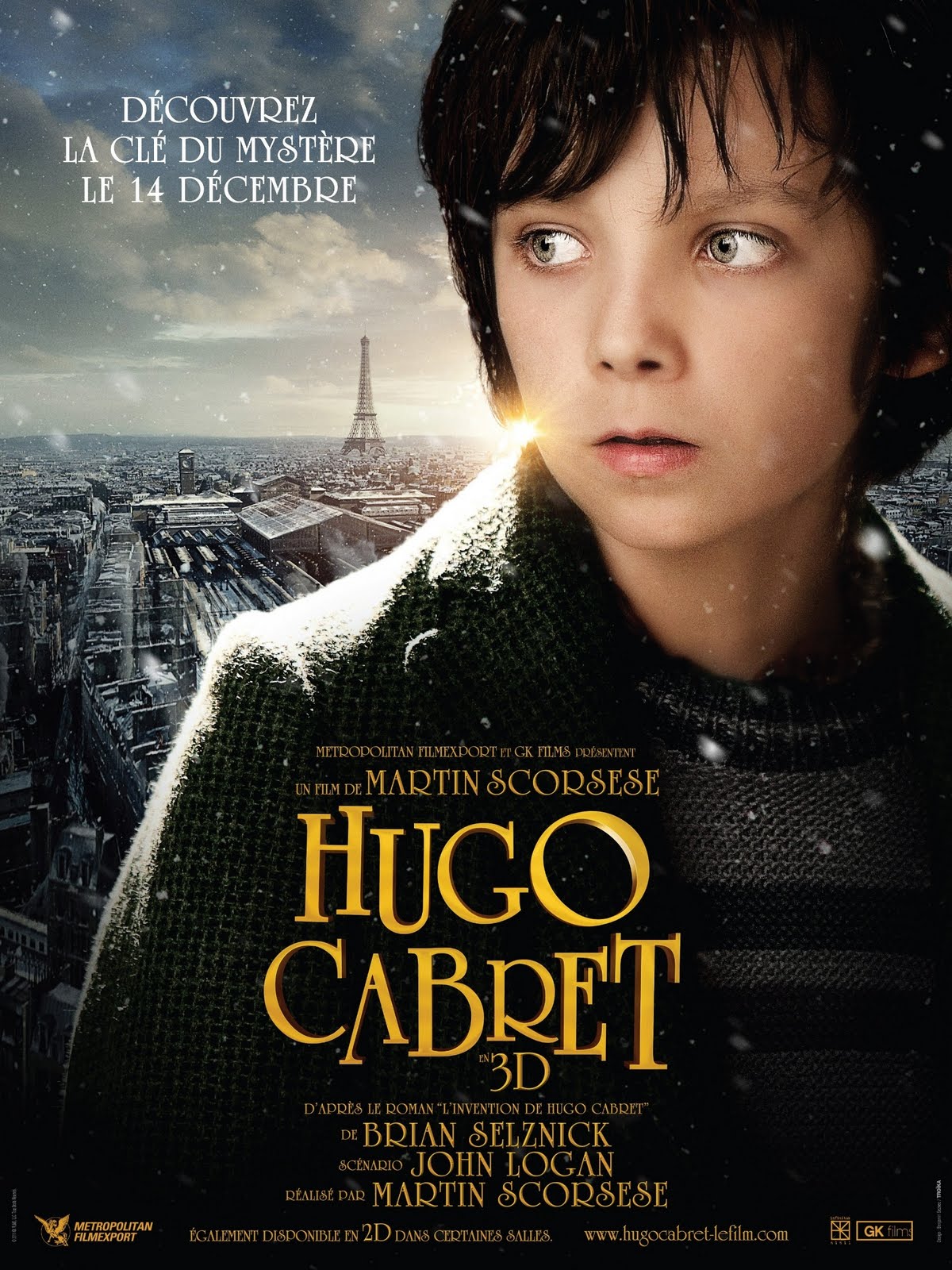
This weekend I saw 'Hugo,' the big screen adaptation of the 'Hugo Cabret' book by Brian Selznick. It was the first time I'd never seen a film in 3D, which until now I had dismissed as just another Hollywood substitution for character or story. But it really added a lot to the visual experience of the film, and didn't give me a headache, either. So other than the $13 ticket price and slightly dark image, yay 3D!As for the film: 'Hugo' had me from the opening shot, which starts high above Paris of the 1930s and then swoops down into the sprawling glass and steel shed of an idealized (and now long gone) Gare Montparnasse, once one of the city's great train stations. Of course anything with a big city European train shed and steam engines, plus lots of mechanical clock machinery and scenes of baked goods and then old film would have been more than enough for me. It could have been a documentary about the effect of the Great Depression on French post-Symbolist poetry; I would have been happy to just watch scenes of the station and eye the croissants for two hours.
Yes, the film did have a story—one involving the French film pioneer Georges Méliès, no less, and yay again for that. But the reason for this post is to examine a specific point made in the story, when the question of "Why We're Here" once again rears its unanswerable head. In this case, with clocks all about, it's only natural that the question is answered in terms of machinery. So here's what I wrote to an acquaintance who saw the film with me:
"At one point, Hugo says that clocks or machines have only just the parts they need—no more, no less. From this, he extrapolates a reason for each person's existence: everyone must have a purpose, or he or she wouldn't be here. And though it's not said explicitly in the film, it's an argument for our universe reflecting a master design of some higher power or another.
"It's a nice thought, but I find it doesn't sit well with me. To me, such a notion seems kind of limiting or dismissive of humanity—to think that we need to justify our existence and that we MUST have a reason for being here. To me, the essence of being human is our ability to transcend the absolutely necessary (very much unlike a watch part) and do things that are completely unnecessary, such as make art or do cartwheels.
I'm not saying the "we're all like parts in a wonderful clock" answer is wrong. But it's not the right one for me, as it seems at odds with the one thing about humans that sets us apart from so much else: our capacity for whimsy and creativity and imagination. We don't always do what's necessary. Heck, we sometimes do things that make no sense at all, often again and again.
Consider: insanity is commonly illustrated as a person doing the same thing over and over again and expecting different results. Well, humans have been asking "Why are we here?" for ages, and not getting an answer, and yet we continue to do it. Given that we know in advance that we can't know an answer for sure (which is a scary thing to most people, hence the popularity of religious systems and beliefs), then it's a remarkably human thing for us to keep asking. It's like we're in a casino in front of the biggest slot machine of them all, and the chances of hitting the huge jackpot are infinitesimally small and might well be zero for all we know, and yet we keep pulling the handle again and again. Insane? Maybe. Human? Yes!
I like the idea of the human potential for unexpected randomness, and sense there may be something holy in it. I've long felt this way, even without thinking about it, and even while growing up marinated in the teachings of the Catholic church. When I attended Fordham University in New York City, I would annoy my new city friends while crossing streets in Manhattan by suddenly diving down to the pavement, somersaulting, and then standing back up again and continuing on as if nothing had happened. Asked why I did that, I'd reply along the lines that I was just making sure I still had free will, that's all. Oh, there's the hick from New Hampshire, at it again!
Yes, everyone wants to be needed. It's an important part of life. But equally important to our humanity, I think, is to preserve and exercise and celebrate our ability to do things that are totally unnecessary.
I think it would make a great basis for a church: that people all get together once a week and do something completely unexpected to celebrate their humanness. Plus, you could get a tax write-off.
And speaking of that: if the current U.S. tax code isn't a celebration of the human capacity for the unnecessary, then I don't know what is.
Thursday, August 25, 2011
Keeping score
Heard something on a BBC radio report the other day. A Hong Kong guy was interviewed about discrimination and prejudice in his life. He's an ethnic Indian, and the point of the interview was discuss what roadblocks he's run into in his business career.
One thing the guy said stuck with me. In describing his own lack of prejudice, he said he has nothing against anyone based on religion, race, or sexual orientation. He summed up his philosophy as:
"If knowing you is something that can help me make money, then you are my friend. But if knowing you is somehow going to cost me money, then you are not my friend."
What a way to evaluate people. Contrast that with what I recall Vonnegut saying in praise of someone: "He didn't keep score with money." That's a far better way to go through life, I think.
Sunday, July 31, 2011
Berle, Hackett, and pocket change
I defy anyone to analyze this dream I just had and come up with some coherent meaning. I dreamed of a TV talk show with Milton Berle and Buddy Hackett at a round wooden table. There's no audience, and the set is one of those daytime TV kitchens. Berle mentions at one point that he's "almost 90" but he's vibrant and alert and full of beans. Hackett functions as his stooge. And the show consists of Berle taking out a bag of pocket change and spilling it onto the table, then picking out one coin, and then reminiscing about that date: show biz, personal life, history, whatever.
The show had the feel of some kind of PBS thing, like the old Steve Allen "Meeting of the Minds" show. It's not a bad idea, and it appeared in my dream as a finished and polished production.
Where did that come from?
And now, I've just gone to find an image for this post, and to do so I entered "Milton Berle Buddy Hackett" just to see what would come up, and look what did: an image of Berle, Hackett, and Steve Allen. I should have mentioned Ernie Kovacs and Lucille Ball, because it would have been fun to see them in the picture as well.
Sometimes life is a little weird.
Subscribe to:
Posts (Atom)