Sunday, December 25, 2011

The Language of Politics

Two language-related things are on my mind this morning, enough so to write about them here.

• I'm disenchanted at just how entrenched the "liberal/conservative" distinction has become in the United States, as if it's a distinction that comes from nature, such as "man/woman" or "day/night." It isn't. It's just a nearly useless distinction that inhibits creative thinking, impedes our ability to communicate, and oversimplifies everything. It reduces options at a time when we need flexibility, and divides us when we need cooperation. Thanks to win-at-all-cost blowhards on the right who have propagated this distinction for the past two decades, thus coarsening the nation's political dialogue for a generation, maybe more.


• I'm tired of hearing about "job creation" as the aim of government policy, as if the direct purpose of government is to create jobs. It isn't. Business creates jobs. Government oversees business to protect the people. Thinking that government itself can create jobs is like thinking that straw can be spun into gold. It can't. And thinking this shows a lack of understanding of how economic wealth is created. It is created by adding value. Government does not do this.

Talk of government "creating jobs" sounds especially silly coming from politicians who seek to reduce the role of government in the lives of citizens. Okay, I know such people actually mean they want government to get out of the way so businesses can grow and prosper. These days, however, businesses often seek growth not by hiring people, but by being more efficient, which means using fewer people, or outsourcing work to places where labor is cheaper. But I digress.

Back to the idea that government can create jobs. This reminds me of when my brother travelled to Norway in the 1980s as part of U.S. Army cold weather survival exercises with the Norwegian military. He and his squadron flew commercially, and had to change planes at London's Heathrow Airport. While there, he was amazed to see women standing at the bottom of escalators whose job was to stand in place and urge people to use caution when mounting the moving staircase.

Absurd, right? Even after a decade of Thatcherism (including, by then, privatization of British Airways), what my brother thought of as "the post World War II British welfare state" was still alive and kicking. However you feel about it, that's the result when government creates jobs.

So let's stop talking about government as if it can create jobs. We're giving it way more credit that it deserves. Businesses create jobs. And people create businesses. And government, ideally, has as much to do with the process as the referee in a hockey game.


• P.S. In reading new coverage about politics, I've noticed a verb that's suddenly being used everywhere. It's "to pivot," as in a candidate pivoting during a campaign. It's used like this, seen on www.politico.com last week: "The pivot to attacking Paul marks the first time Gingrich has launched an unprovoked broadside against another Republican candidate."

The implication, I guess, is that a candidate keeps his or her positions and efforts and overall operation intact, but now swings them in some new direction without the use of much additional energy or groundwork, rather like one of those machine guns mounted on the back of a pick-up truck often seen in ungoverned regions. Well, that's not the most encouraging illustration, but that's what comes to mind when I hear the word.

I suppose it's a useful expression, but I'm suspicious of any sudden increase in the use of any word or phrase in a new context. If it was that useful, it would have been out there more often all long, right? So to me, a sudden new buzzword smells of flavor-of-the-month intellectual laziness, a kind of mental shorthand that does not enhance our ability to communicate with precision. It's just one more brick in the wall of thoughtless thinking, another step on the road to the city where we don't have the ability to think for ourselves.

I hope civilization never pivots that way.

Saturday, December 17, 2011

The virtues of being incomplete

I believe the best kind of art is that which engages one's imagination. This explains, I think, my interest in such archaic forms as silent film and network radio: each lacked an element, which had to be provided by its audience. And that, in turn, made the experience more personal and individual and real.

I've just breezed through 'A Man Without a Country,' the slim volume of musings issued by Kurt Vonnegut in 2005, and in it (among many recycled ideas from his earlier work) are thoughts on what Vonnegut calls "the imagination circuit." These below pertain to visual art such as paintings or drawings:
"If you go to an art gallery, here's just a square with daubs of paint on it that haven't moved in hundreds of years. No sound comes out of it."
So I guess paintings or sculpture might fall into the same category — they require viewers to collaborate, though they're not usually trying to tell a story in the same way more narrative forms (film or radio) do.

A similar collaborative process happens with reading: we take these little marks (which I'm using right now) and run them through our minds to create pictures that appear to us, however fleetingly, in ways that only we could have imagined. They're private little epiphanies, though fueled by the shared experience of watching or listening or looking.

Regarding those "imagination circuits," Vonnegut writes that...
"...it's no longer necessary for teachers and parents to build these imagination circuits. Now there are professionally produced shows with great actors, very convincing sets, sound, music. Now there's the information highway. We don't need the circuits any more than we need to know how to ride horses."
Vonnegut leaves it at that, without making a judgment, though he doesn't seem to be too enthused by the situation. For me, I can't speak against today's movies and television shows, as I enjoy them as much as the next person. Rather, I wish to raise my hand and point out that older, incomplete forms did have their own unique power to communicate, and still do. That power is rooted in their very incompleteness, which requires people to use their imagination.

And I think those who have a certain kind of imagination can still get a lot from older forms. Once your imagination is engaged, it's possible to enter a meditation-like trance stage that is the launching pad for emotions that are bigger and intense and personal than if you are a mere spectator, which is what you are when everything's given to you on a silver platter, or screen.

Even when movies began being made with color and sound as a matter of course, the great directors understood the importance of not showing. Alfred Hitchcock was a master at the "less is more" school — he often did not show scenes of violence, instead leaving it up to the viewer's imagination, knowing full well that we would envision something many times more frightening that any image he could have put on the screen. Why? Because, left on our own, we can't help but fill in the blanks, so to speak, with images that resonate with us personally.

In an age of alienation, I think these kinds of collaborative art are good for the soul. They involve us and make us feel a part of something, and can tap into emotions that are more abstract and bigger. By giving up some elements, we can gain so much. Call it the new primitivism. There, I just did.

I suppose by this thinking, a "Mad Lib" qualifies as great art, as you choose words to fill in the text of a story. Could be. That's a ___________adjective idea if I ever heard one.

Monday, December 5, 2011

The human potential for unexpected randomness

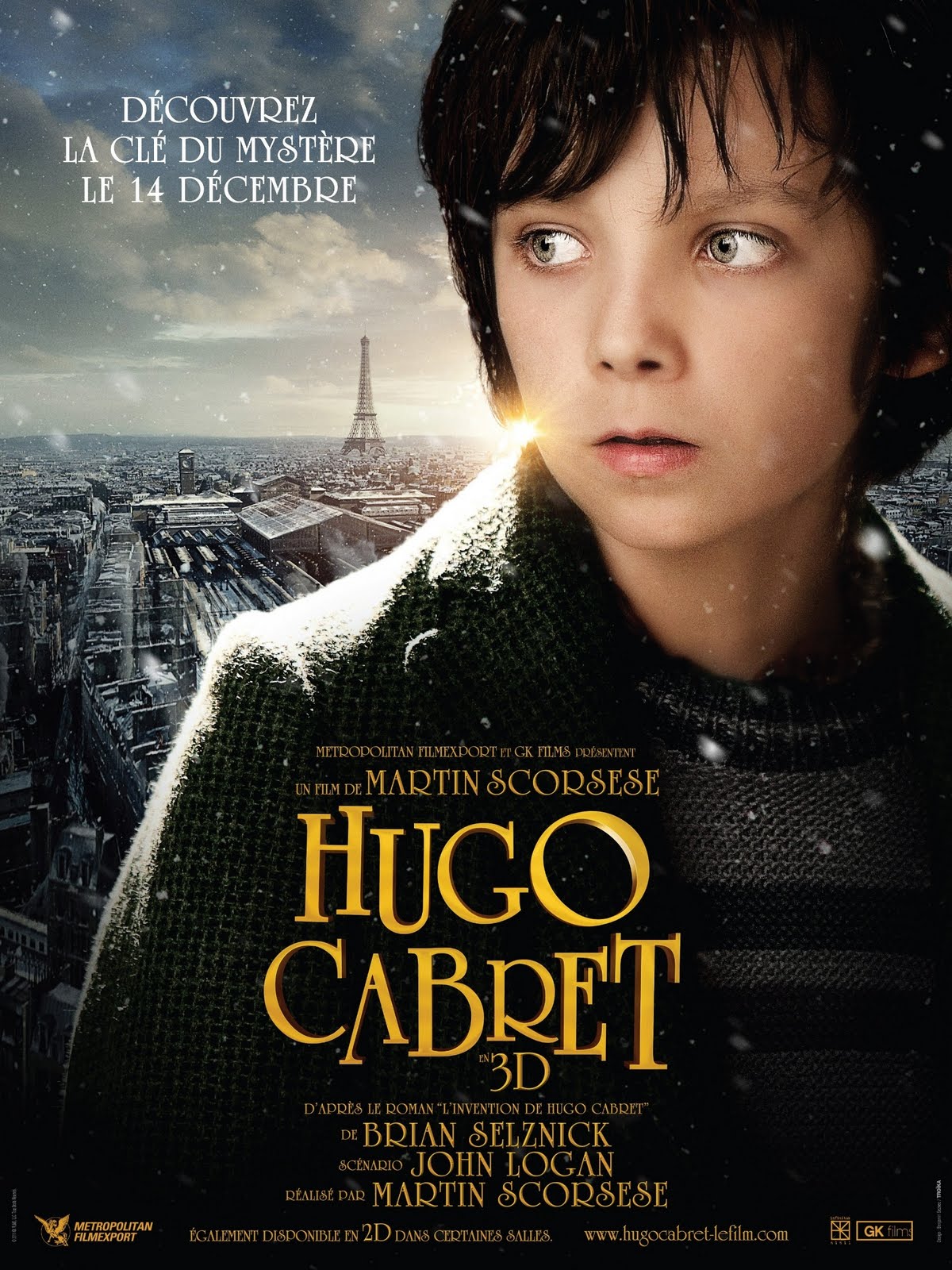
This weekend I saw 'Hugo,' the big screen adaptation of the 'Hugo Cabret' book by Brian Selznick. It was the first time I'd never seen a film in 3D, which until now I had dismissed as just another Hollywood substitution for character or story. But it really added a lot to the visual experience of the film, and didn't give me a headache, either. So other than the $13 ticket price and slightly dark image, yay 3D!

As for the film: 'Hugo' had me from the opening shot, which starts high above Paris of the 1930s and then swoops down into the sprawling glass and steel shed of an idealized (and now long gone) Gare Montparnasse, once one of the city's great train stations. Of course anything with a big city European train shed and steam engines, plus lots of mechanical clock machinery and scenes of baked goods and then old film would have been more than enough for me. It could have been a documentary about the effect of the Great Depression on French post-Symbolist poetry; I would have been happy to just watch scenes of the station and eye the croissants for two hours.

Yes, the film did have a story—one involving the French film pioneer Georges Méliès, no less, and yay again for that. But the reason for this post is to examine a specific point made in the story, when the question of "Why We're Here" once again rears its unanswerable head. In this case, with clocks all about, it's only natural that the question is answered in terms of machinery. So here's what I wrote to an acquaintance who saw the film with me:

"At one point, Hugo says that clocks or machines have only just the parts they need—no more, no less. From this, he extrapolates a reason for each person's existence: everyone must have a purpose, or he or she wouldn't be here. And though it's not said explicitly in the film, it's an argument for our universe reflecting a master design of some higher power or another.

"It's a nice thought, but I find it doesn't sit well with me. To me, such a notion seems kind of limiting or dismissive of humanity—to think that we need to justify our existence and that we MUST have a reason for being here. To me, the essence of being human is our ability to transcend the absolutely necessary (very much unlike a watch part) and do things that are completely unnecessary, such as make art or do cartwheels.

I'm not saying the "we're all like parts in a wonderful clock" answer is wrong. But it's not the right one for me, as it seems at odds with the one thing about humans that sets us apart from so much else: our capacity for whimsy and creativity and imagination. We don't always do what's necessary. Heck, we sometimes do things that make no sense at all, often again and again.

Consider: insanity is commonly illustrated as a person doing the same thing over and over again and expecting different results. Well, humans have been asking "Why are we here?" for ages, and not getting an answer, and yet we continue to do it. Given that we know in advance that we can't know an answer for sure (which is a scary thing to most people, hence the popularity of religious systems and beliefs), then it's a remarkably human thing for us to keep asking. It's like we're in a casino in front of the biggest slot machine of them all, and the chances of hitting the huge jackpot are infinitesimally small and might well be zero for all we know, and yet we keep pulling the handle again and again. Insane? Maybe. Human? Yes!

I like the idea of the human potential for unexpected randomness, and sense there may be something holy in it. I've long felt this way, even without thinking about it, and even while growing up marinated in the teachings of the Catholic church. When I attended Fordham University in New York City, I would annoy my new city friends while crossing streets in Manhattan by suddenly diving down to the pavement, somersaulting, and then standing back up again and continuing on as if nothing had happened. Asked why I did that, I'd reply along the lines that I was just making sure I still had free will, that's all. Oh, there's the hick from New Hampshire, at it again!

Yes, everyone wants to be needed. It's an important part of life. But equally important to our humanity, I think, is to preserve and exercise and celebrate our ability to do things that are totally unnecessary.

I think it would make a great basis for a church: that people all get together once a week and do something completely unexpected to celebrate their humanness. Plus, you could get a tax write-off.

And speaking of that: if the current U.S. tax code isn't a celebration of the human capacity for the unnecessary, then I don't know what is.

Thursday, August 25, 2011

Keeping score

Heard something on a BBC radio report the other day. A Hong Kong guy was interviewed about discrimination and prejudice in his life. He's an ethnic Indian, and the point of the interview was discuss what roadblocks he's run into in his business career.

One thing the guy said stuck with me. In describing his own lack of prejudice, he said he has nothing against anyone based on religion, race, or sexual orientation. He summed up his philosophy as:

"If knowing you is something that can help me make money, then you are my friend. But if knowing you is somehow going to cost me money, then you are not my friend."

What a way to evaluate people. Contrast that with what I recall Vonnegut saying in praise of someone: "He didn't keep score with money." That's a far better way to go through life, I think.

Sunday, July 31, 2011

Berle, Hackett, and pocket change

I defy anyone to analyze this dream I just had and come up with some coherent meaning. I dreamed of a TV talk show with Milton Berle and Buddy Hackett at a round wooden table. There's no audience, and the set is one of those daytime TV kitchens.

Berle mentions at one point that he's "almost 90" but he's vibrant and alert and full of beans. Hackett functions as his stooge. And the show consists of Berle taking out a bag of pocket change and spilling it onto the table, then picking out one coin, and then reminiscing about that date: show biz, personal life, history, whatever.

The show had the feel of some kind of PBS thing, like the old Steve Allen "Meeting of the Minds" show. It's not a bad idea, and it appeared in my dream as a finished and polished production.

Where did that come from?

And now, I've just gone to find an image for this post, and to do so I entered "Milton Berle Buddy Hackett" just to see what would come up, and look what did: an image of Berle, Hackett, and Steve Allen.

I should have mentioned Ernie Kovacs and Lucille Ball, because it would have been fun to see them in the picture as well.

Sometimes life is a little weird.

Thursday, July 28, 2011

Hey, there's de-icer in my ice cream!

Every once in awhile I make a connection between two disparate areas of interest. The other day it was ice cream and airports. My wife has been bringing home tubs of a certain brand of ice cream (yay!) that I enjoy. But then I actually read the ingredients, and I was surprised to see "propylene glycol" listed. I'm no chemist, but my obsession with airports (see Airline Terminal Mania) allowed me to recognize this as a key ingredient in aircraft deicing fluid. And that can't be good. (The brand is Edy's, by the way.)

So I checked around and yes, propylene glycol is considered safe to ingest, and is often added to processed foods to help them retain moisture. Fine, but that's not enough to reassure me. I can't help but think of the "high fructose corn syrup" factor in this. That chemical, which replaced sugar as a sweetener in most processed foods in the U.S. around 1980, is considered safe, too, but I'm convinced it has long-term effects that we just aren't aware of. I've tried to eliminate it from my diet, but that's not always easy in the land of overprocessed foods. Still, it's been a long time since I've thoughtlessly swigged soda sweetened with HFCS.

One interesting thing about high fructose corn syrup is that it was developed by the Japanese, which made me want to write an international conspiracy thriller where high fructose corn syrup was exposed as a plot by the Japanese to get even with the U.S. for bombing Hiroshima and Nagasaki. Stay tuned on that one.

Back to ice cream: So yesterday, the grocery fairy caused a tub of another brand of ice cream to materialize in the freezer—this one marketed on its packaging as "all natural." That can mean anything, but I looked, and sure enough, there was no propylene glycol listed in the ingredients. And you know what? It kinda tasted better and felt more "right" going down.

How much of that is just psychological I'm not prepared to say. But it's me and all my hang-ups and emotions and non-scientific judgments that are in charge of what I actually eat, and that's good enough for me to steer clear of deicer in my ice cream from now on.

Except maybe in winter.

Thursday, June 30, 2011

Two books, two worlds

Moving books around the house has prompted me to re-read a couple of favorites.

One is 'North of Monadnock,' a 1961 collection of essays about life in back-country New Hampshire by Newt Tolman, a man my father knew. The other is 'Shock Value,' a collection of essays by schlock auteur John Waters, published in 1981, just after his most fertile period of movie-making, I think.

I love both books. But the worlds they come from could not be more different.

One is old-time Yankee writings from a guy whose family had lived in Nelson, N.H. since before the Revolution, and still does. The other is the proto-punk musings of a filmmaker from Baltimore whose aim at the time was to shock the sensibilities of the American middle class.

But these two books (and their authors) have more in common than you might first realize.

First, they are both written by individuals with a worldview that is complicated and interesting and all of a piece. The worlds are worlds apart, yes, but both writers are able to make a compelling (and entertaining!) case for them.

And their views flow naturally from their life experiences, which take place in settings that are completely different from each other -- one rural New Hampshire, the other urban Baltimore. I find each man's response to life completely justifiable, given their backgrounds.

But the most important connection they both share is subversion. The energy in Tolman's writing, it seems, comes primarily from a desire to dispel a hundred clichéd notions about quaint Yankee life. The old-time country store was not a friendly down-home kind of place, but a filthy rat hole often run by the most disreputable character in town. (Being a shopkeeper was no life for a grown man, it was felt.) The subversion in the Waters book is far more obvious: when Lady Divine's Cavalcade of Perversion includes 'The Human Puke Eater,' it's hard to miss.

I think I'm drawn to both books, to the point of wanting to spend time reading them again when so many other books beckon, because both men succeed in explaining their worlds so thoroughly and completely and entertainingly. They are both superb tour guides to places they know very well, and both trips are so good they're worth taking again. Hence the re-reading.

For me personally, the Tolman book represents my childhood, and not just in a general way. We spent our summers in that area (where my dad grew up) when I was a kid. I personally knew a few of the people Tolman writes about, and got just enough of a whiff of the whole scene for everything he relates to really resonate.

The Waters book, I think, represents my rebellion -- not in any specific way (I didn't go to Baltimore and join in the underground film scene), but the general rebellion that all adolescents work through in their own ways. In my case, I rebelled by going to college in New York City and eating at the White Castle.

But both books are windows into worlds worth knowing. I'm glad the great slot machine of life somehow led me to them long ago, and glad for the chance to revisit them. It's a rare case of me being grateful for being a packrat, and I'll take it.